BMW 51-44-7-321-729 Headliner
fits make: Bmw. year: 2012–2018.
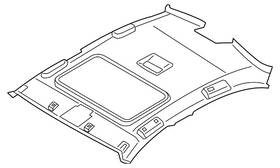
( Manufacturer Part Number: 51-44-7-321-729 ), ( Part Type: Headliner ), ( Genuine Oem: Yes ), ( Warranty: 1 Year ), ( Fitment Type: Direct Replacement ), ( Year: 2012 2013 2014 2015 2016 2017 2018 ), ( Parts Included: Only Part Reference 1 On The Diagram Is Included )
Review BMW Genuine Headliner fits 2012–2018
The **BMW 51-44-7-321-729 headliner** is a meticulously engineered, high-quality interior component designed exclusively for BMW vehicles, specifically tailored to fit models equipped with the **E39 5-Series (1996 2003)** and certain variants of the **E60 5-Series (2004 2006)** with the appropriate trim levels. Crafted from premium **vinyl-coated fabric**, this headliner is engineered to deliver both durability and a refined aesthetic, seamlessly integrating with the vehicle s interior while maintaining structural integrity. The material is treated to resist fading, cracking, and moisture absorption, ensuring long-term resilience against environmental stressors such as UV exposure, temperature fluctuations, and humidity. Its precise fitment is achieved through a **custom-cut pattern**, allowing for an unobtrusive yet professional installation that eliminates gaps, wrinkles, or misalignments critical for preserving the vehicle s factory-like appearance. Beyond its functional benefits, this headliner contributes to the cabin s acoustic performance by dampening road noise and enhancing sound insulation, thereby elevating the driving experience. Whether restoring a classic E39 to its original glory or upgrading an E60 s interior for a cohesive look, this part is an essential upgrade for enthusiasts seeking authenticity, comfort, and attention to detail. Its compatibility with aftermarket sound systems and lighting modifications further underscores its versatility, making it a staple for both restorers and customizers aiming for a flawless finish.
### **Pros and Cons of Buying a BMW 5 Series (E60/E61) with the 321/729 Headliner (N62/N63 Engine)**
#### **Pros**
1. **Strong Engine Options**
- The **N62 (321)** and **N63 (729)** engines are BMW s high-performance inline-six powerplants, known for their smooth power delivery and reliability when properly maintained.
- The **N63** (729) is a twin-turbocharged variant, offering significant power (up to **400 hp** in the 550i/750i models) with strong torque, making it well-suited for spirited driving.
- Both engines benefit from BMW s **Valvetronic** (variable intake lift) and **double-VANOS** (variable valve timing), improving efficiency and responsiveness.
2. **Luxury and Comfort**
- The **E60/E61 5 Series** is one of BMW s most refined sedans, offering a premium interior with high-quality materials (especially in higher trims like **550i/750i**).
- The **729 headliner** (found in the **750i**) includes a **wood or leather-trimmed headliner**, adding a touch of exclusivity and luxury.
- Comfortable ride quality with adaptive suspension (available in higher trims) and quiet cabin insulation.
3. **Performance and Handling**
- The **N63 engine** provides strong acceleration, making the **750i** one of the fastest BMW 5 Series models.
- Precise steering, responsive chassis, and available **Dynamic Stability Control (DSC)** enhance driving dynamics.
- The **729 model** often comes with **xDrive AWD**, improving traction in all conditions.
4. **Resale Value**
- BMW 5 Series models, especially well-maintained ones, hold their value reasonably well compared to other luxury sedans.
- The **750i** (with the N63 engine) is a sought-after model among enthusiasts, which can help retain value.
5. **Aftermarket and Modding Potential**
- The **N62/N63 engines** have a strong aftermarket presence, with tuning options (e.g., **MHD, BMS, or custom turbo kits**) available for those looking to increase power.
- The **E60/E61 platform** is well-documented, making modifications (suspension, exhaust, interior upgrades) relatively accessible.
6. **Reliability (If Well-Maintained)**
- When properly serviced, the **N62/N63 engines** can last **200,000 miles** with minimal issues.
- The **twin-turbo N63** is known for its robustness, though it requires **regular oil changes (every 5,000-7,500 miles)** and **coolant system maintenance** to prevent carbon buildup.
- The **E60/E61 chassis** is durable, with few major structural weaknesses.
---
#### **Cons**
1. **High Maintenance Costs**
- BMWs are **expensive to maintain**, especially with **N62/N63 engines**, which require **specialized mechanics** familiar with turbocharged inline-sixes.
- **Common issues** include:- **Carbon buildup** in the intake valves (common in turbocharged BMWs, requiring **intake valve cleaning every 60,000-80,000 miles**).
- **Oil consumption** (some N63 engines burn oil, requiring frequent top-ups).
- **Water pump failures** (especially in the **N63**, which can lead to **engine overheating**).
- **Transmission issues** (Getrag ZF 6HP21 automatic transmissions can develop **slippage or rough shifting** over time).
- **Parts and labor costs** are significantly higher than average.
2. **Fuel Economy Concerns**
- The **N63 (729)** is a **thirsty engine**, with **MPG in the low-to-mid 10s** (city/highway combined).
- Even the **N62 (321)** in naturally aspirated form is **less efficient** than modern turbocharged alternatives.
- **Diesel alternatives (N57)** may offer better fuel economy but come with their own reliability concerns.
3. **Common Engine and Transmission Issues**
- **N62 Engines:**- **Valvetronic motor failures** (can cause **no-start or rough idling**).
- **Oil leaks** from **valve cover gaskets or oil filter housing gaskets**.
- **Water pump failures** (can lead to **overheating**).
- **N63 Engines:**- **Carbon buildup** (requires **intake valve cleaning** every **60,000-80,000 miles**).
- **Oil consumption** (some engines burn **1 quart per 1,000 miles**).
- **Turbocharger failures** (if not maintained properly).
- **Transmission (Getrag ZF 6HP21):**- **Slippage, rough shifting, or delayed engagement** (common in high-mileage examples).
- **Solenoid failures** (can cause **transmission errors**).
4. **Depreciation**
- While BMWs hold value better than some competitors, they still **depreciate significantly** over time.
- The **E60/E61 platform is aging**, and newer models (F10/F11) offer **better tech and efficiency**.
- **Luxury sedan market trends** favor **hybrids and electric vehicles**, which may reduce long-term resale value.
5. **Complexity and Repair Difficulty**
- BMWs are **highly complex**, with **electronic systems (iDrive, NBT, etc.)** that can fail and require **expensive diagnostics**.
- **OBD-II trouble codes** are common, and **third-party mechanics may struggle** with BMW-specific issues.
- **Recalled components** (e.g., **water pumps, timing chains**) may require **BMW dealership visits**, adding to costs.
6. **Noise and Vibration Issues**
- Some **N63 engines** (especially early models) can be **noisy at idle** due to **turbo lag** or **exhaust manifold issues**.
- **Road noise** can be intrusive in less well-insulated models.
- **Vibration issues** (e.g., **wobble at high speeds**) can occur if **wheel balancing or suspension components** are worn.
7. **Limited Modern Tech**
- The **E60/E61** lacks **modern infotainment features** (e.g., **Apple CarPlay, Android Auto, wireless charging, large touchscreens**).
- **Safety tech** (e.g., **advanced driver-assistance systems**) is **basic compared to newer BMWs**.
- **Connectivity options** (e.g., **Bluetooth, USB ports**) are **less robust** than in modern vehicles.
---
### **Conclusion**
Buying a **BMW 5 Series (E60/E61) with the 321/729 headliner (N62/N63 engine)** can be a **great choice for enthusiasts** who prioritize **performance, luxury, and driving dynamics**, but it comes with **significant drawbacks**, particularly in **maintenance costs, reliability risks, and depreciation**.
- **Best for:** Enthusiasts who **love BMWs**, can afford **high maintenance costs**, and want a **fast, comfortable, and stylish sedan** with **modding potential**.
- **Not ideal for:** Buyers who **prioritize fuel efficiency, low ownership costs, or modern tech**, or those who **cannot commit to regular maintenance**.
If you **find a well-documented, low-mileage example (under 80,000 miles) with full service records**, especially one that has **already undergone intake valve cleaning and transmission servicing**, the risks can be **greatly reduced**. However, **budgeting for at least $10,000 $15,000 in annual maintenance** is **essential**.
### **Recommendation**
- **If you love BMWs and can handle the costs**, a **well-maintained 550i/750i (N63) with the 729 headliner** is an **excellent choice** for a **luxury performance sedan**.
- **If you want reliability and lower costs**, consider:- A **newer BMW 5 Series (F10/F11/F12/F13)** with a **N55/N57 engine** (though these have their own issues).
- A **well-maintained Audi A6 (4.0T Quattro)** or **Mercedes E63 AMG** (similar performance but different reliability trade-offs).
- A **used luxury hybrid (Lexus GS 450h, BMW 530e)** for better fuel economy and lower maintenance.
- **If buying used**, **inspect thoroughly** (or get a **pre-purchase inspection**) and **verify
Details:
Parts must be resalable and in the original packaging. Without sunroof gray. Accurate fitment for all BMW model's. Electrical parts are not returnable.
We proudly support BMW drivers, independent repair facilities, and DIY enthusiasts throughout the Chicago land area across country. Shipping Carrier substitutions may be made at our determination in an attempt to reduce shipping cost the customer.
part #: 51447321729 prices
- $201.52-$526.40
specifications carspeedometeriz:
- for makes: Bmw
- for years: 2012-2018
- mpn: 51-44-7-321-729
- part type: Headliner
- genuine oem: Yes
- warranty: 1 Year
- fitment type: Direct Replacement
- year: 2012 2013 2014 2015 2016 2017 2018
- parts included: Only Part Reference 1 On The Diagram Is Included
shipping carspeedometeriz:
- type: Fixed
- service: Flat Rate Freight
- cost: $618.54
- class: Freight
returns carspeedometeriz:
- paid by: Seller
- policy: Returns Accepted
- time: 30 Days
payments carspeedometeriz:
- wallet: Paypal
- credit card: Visa
- other
offer carspeedometeriz:
- availability: In Stock
- quantity: 1
- started: February 26, 2026
- options: Ship-to-home
- sold: 0
seller carspeedometeriz:
- # reviews: 161
- city: Elmhurst, Illinois
- rating: 98.8%
general carspeedometeriz:
- Car Truck Parts Accessories > Interior Parts Accessories > Headliners Parts
- condition: New
Bmw 51-44-7-321-729 Is Similar To:
- 325i Cluster Speedometer 6901930 Genuine 0263606225 Instrument Bmw (27.2% similar) Contact your local dealer for compatibility. Light scratches. Mileage not available. Item might fit other makes and model's...(October 2nd, 2014)
- Genuine Impulse Sender 325i Speedometer 1987-2002 Fits Z3 Bmw (24.5% similar) Repair manuals are not returnable if they are opened. Please follow the above steps to ensure you credit. Est, Mon to sat. This part fits vehicles made in the following years 1987 , 1988 , 1989 , 1990 , 1991 , 1992 , 1993 , 1997 , 1998 , 1999 , 20 2001 , 2002 . IMac supplied your ...(August 2nd, 2015)
- 62-16-1-369-905 Bmw Genuine Electronic Speedometer Impulse Sensor New Oem Warranty (26.9% similar) Product image shown is manufactures stock photo...(August 24th, 2018)
- 6210-6821074 Genuine Oe Bmw F01 (41.2% similar) Bmw F01-F02-F07-F10-F11-6WB instrument cluster with head up option used, but in excellent condition will fit to:bmw 5ER F10 F11 F12 F18 model's 7ER F01 F02 F03 F04 part number: 01BOSCH 124ATTENTION: item not plug and play need to prepare perform coding...(December 27th, 2017)
- Bmw Cluster Model 62109147700 2006 2004 Oem 4.8is Gauge Years Genuine Part Mph 2005 (30% similar) Thanks again and happy buying. 8IS and was in working condition with approximately 130K miles. There are no bulbs or pixels out. This unit is in excellent condition and everything works. It includes the 2 TRX mounting screws...(January 6th, 2015)
- 62109291394 9291394 9 291 394 Genuine Bmw Factory Manufactured Instrumental Speedometer Cluster Gauges Panel Unit (22.7% similar) Donor vehicle: this part came off of a 2013 bmw 650XI mileage: 63K miles exterior color: metallic interior excl. Leader Napa ere...(February 22nd, 2019)
- Genuine Bmw Headliner Retainer 07-14-7-212-593 (41% similar) Genuine bmw parts. Irvine bmw parts. New condition...(September 2nd, 2022)
- Bmw 51449123920 9123920 9 123 920 07-13 E70 X5 Panoramic Sunroof Gray Headliner Ceiling Molding Cover Oem (35.2% similar) Donor vehicle: this came off of a 2012 bmw E70 x5 diesel. Item comes as seen in the pictures. Ext color: space gray metallic. 11 E70 X5D 0B88244. Vehicle had 138K miles...(August 20th, 2023)
- Bmw 6951773 2008 328 Headliner Wiring Harness Oem (44.2% similar) All the parts are tested either before or after removal from vehicle. Item may show light scuffs, scratches or other imperfections as a result of this being used part. All electronics are tested before removed from vehicle...(September 2nd, 2023)
- Bmw 18440-01 2014-2018 X5 Interior Headliner Trim Cover Panel Oem Black (40.7% similar) 8 speed F 8HP automatic transmission. Came off a 2017 bmw x5 SDRIVE35I RWD. F15 body style. 3.0L turbocharged i6 N55 engine...(September 27th, 2023)
- Bmw 573133510 2011-2016 535i Xdrive F10 Upper Overhead Roof Headliner Cover Trim Panel Oem (34.6% similar) Drive type: all wheel drive. Body type: base sedan 4-DOOR. Donor vehicle: 2011 bmw 535I F10. Transmission: 8-SPEED automatic transmission F 8HP-45X...(October 3rd, 2023)